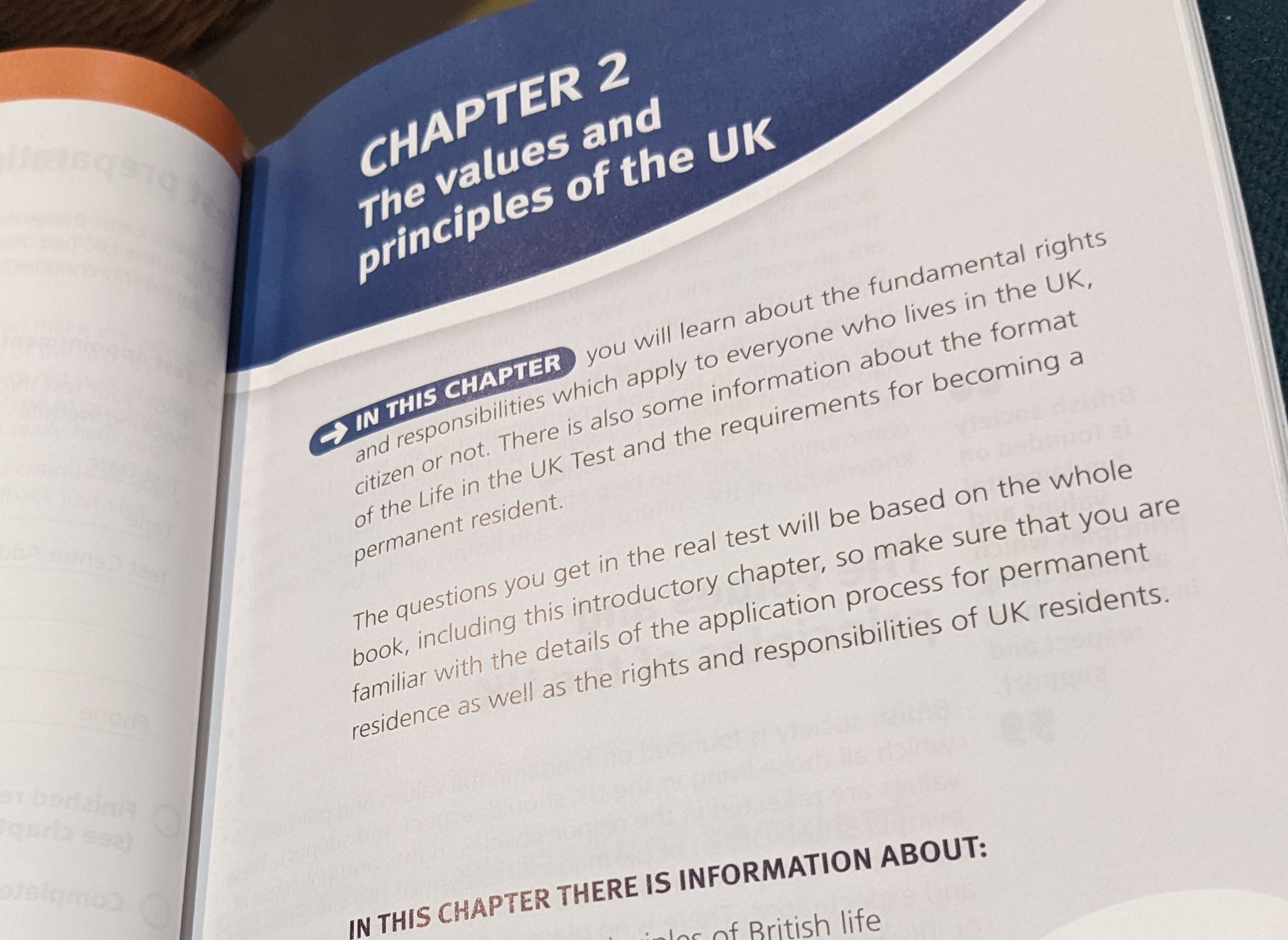
Following chapter two we can find the paragraph “Becoming a permanent resident”.
Naturally information given is partially repetition of what I read in chapter 1 of the handbook.
But because it is mandatory to read every chapter carefully, I cannot skip this part.
So again, to become a permanent or a naturalised citizen of United Kingdom we will need to read & speak English as well as have a good understanding of life in the UK.
It can be achieved by by passing the Life in UK Test and by producing satisfactory evidence of speaking and listening skills in English at B1 of the Common European Framework
of Reference. It is equivalent to ESOL Entry Level 3.
The proof of the English language knowledge can be English test qualification from an approved test centre.
In case of language qualifications I will need to check the Home Office website and when I do so, I will write about my findings in separate post.
Handbook advises to check the latest updates regarding citizenship application requirements on this website too.
I prefer to use words which are given by handbook to make sure I haven’t misinterpreted the meaning.
Going further the handbook tells again about taking the Life in the UK test.
Besides points which I’ve already learnt, handbook say that the test can be take in English but also is possible to take it in Welsh or Scottish Gaelic.
I will rather stick to English though.
Life in the UK test can be taken only at a registered and approved test centres.
There is over 30 of these centres in the UK.
Test can be booked on line only at www.gov.uk/life-in-the-uk-test.
The Home Office will accept only certificates from registered test centres.
There are different arrangements for test takers who live in the Channel Insland or the Isle on Man.
We must read the instructions carefuly when we book the test.
Personal details must be entered carefully and it is necessary to take an ID and a proof of address to the test.
Without these documents we won’t be allowed to take the test.
Then there is short reminder how to use the handbook and that is written the way it can be understood by anyone who can read English at ESOL Entry Level 3.
Glossary at the back of handbook contains key words and phrases and “Check that you Understood” boxes may be very helpful.
More information we can find at:
- the Home Office website – about application process and forms to complete
- the Life in the UK Test website – about the test and how to make a booking
- www.gov.uk – info about ESOL coursed and when you can find one


Comments